Wellness Center Online Scheduling & Client Retention
Wellness centers face a specific challenge that most businesses don’t: they need to manage two completely different service models at the same time. Group classes have fixed times, multiple attendees, and instructor-driven schedules. One-on-one appointments have flexible timing and practitioner-client relationships. Most scheduling software handles one well. Fewer handle both.
Here’s how to build a system that works for both, keeps clients coming back, and turns first-time visitors into long-term members.
Why wellness centers struggle with scheduling:
- Mixed service types (classes and appointments need different workflows)
- High client churn (yoga studios lose 50% of clients within 6 months without active retention)
- Inventory (mats, oils, and supplements sold during visits)
- Membership complexity (unlimited, package, and drop-in pricing all coexist)
- Multi-location management (clients visit any location with one membership)
- Staff scheduling (instructors teach multiple classes per week)
- No-show rate (classes: 20-30% no-show without reminders)
- Revenue tracking (classes, appointments, and retail all count separately)
Types of wellness services:
Group classes:
- Yoga, pilates, spinning, HIIT, meditation, dance
- Fixed time, multiple attendees, instructor-led
- Pricing: per-class, packages (10 classes), or memberships (unlimited)
One-on-one appointments:
- Coaching, personal training, massage, acupuncture, counseling
- Flexible time, individual, practitioner-led
- Pricing: per-session or packages
Retail products:
- Yoga mats, water bottles, supplements, essential oils
- Sold during or after appointments and classes
- Revenue add-on, typically 10-15% of total revenue
Hybrid clients: Some clients do all three: attend group classes, book private sessions, and buy retail. Your software needs to handle all three without creating separate accounts.
Wellness center revenue model:
Membership:
- “Unlimited yoga: $99/month”
- Auto-bills monthly
- High customer lifetime value if clients stay long-term
- Most stable revenue stream
Class packages:
- “10 classes: $150 ($15/class vs. $20 drop-in)”
- Upfront payment
- Encourages commitment
Drop-in:
- “Single class: $20”
- Lowest commitment
- Lowest retention rate
Private sessions:
- Personal training: $60-80/session
- Coaching: $75-100/session
- Higher margins than group classes
Retail:
- Average retail attachment of 10-15% of sessions translates to meaningful additional revenue at scale
Top apps for wellness centers:
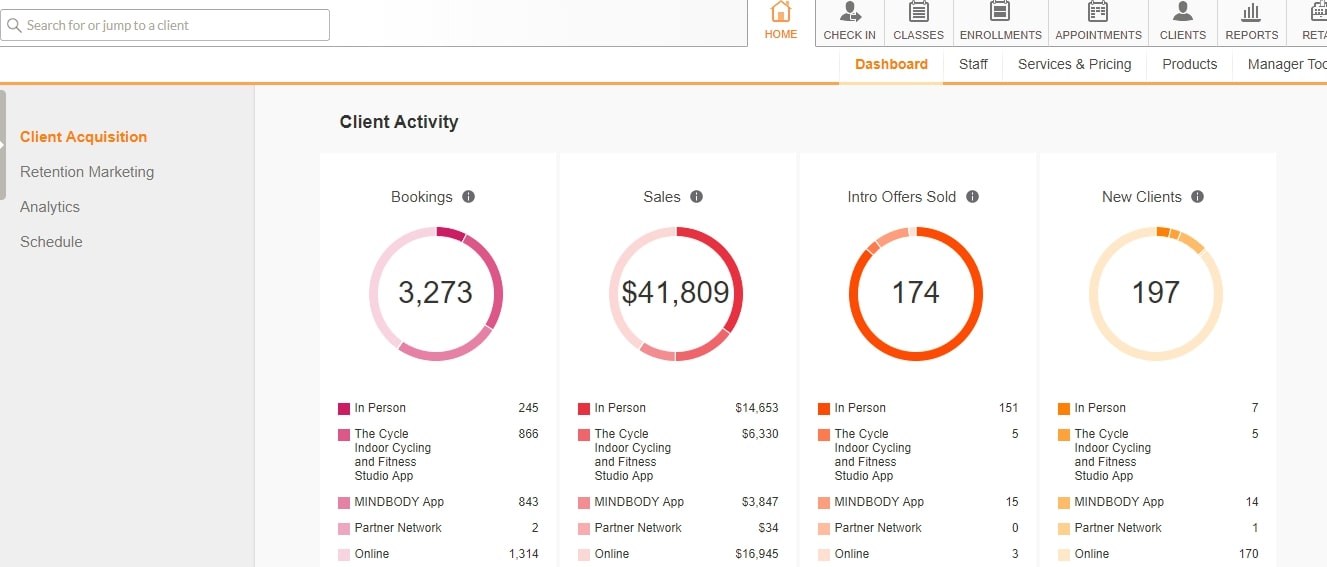
Mindbody (Best comprehensive)
- Class scheduling with unlimited class types
- Membership and package management with auto-billing
- One-on-one appointment scheduling
- Staff and instructor management
- Client CRM with attendance history
- Billing, invoicing, and retail inventory
- Automated marketing (email and SMS)
- Multi-location support
- Cost: $99+/month (Starter); $259+/month for advanced reporting and resource management
- Best for: Established wellness centers with 5+ staff and multiple service types
Vagaro (Best for class-focused wellness)
- Class and group session scheduling
- Membership management and client CRM
- Portfolio and photo gallery
- Online payments and Zapier integration
- Cost: $40+/month
- Best for: Yoga studios and wellness centers focused on classes
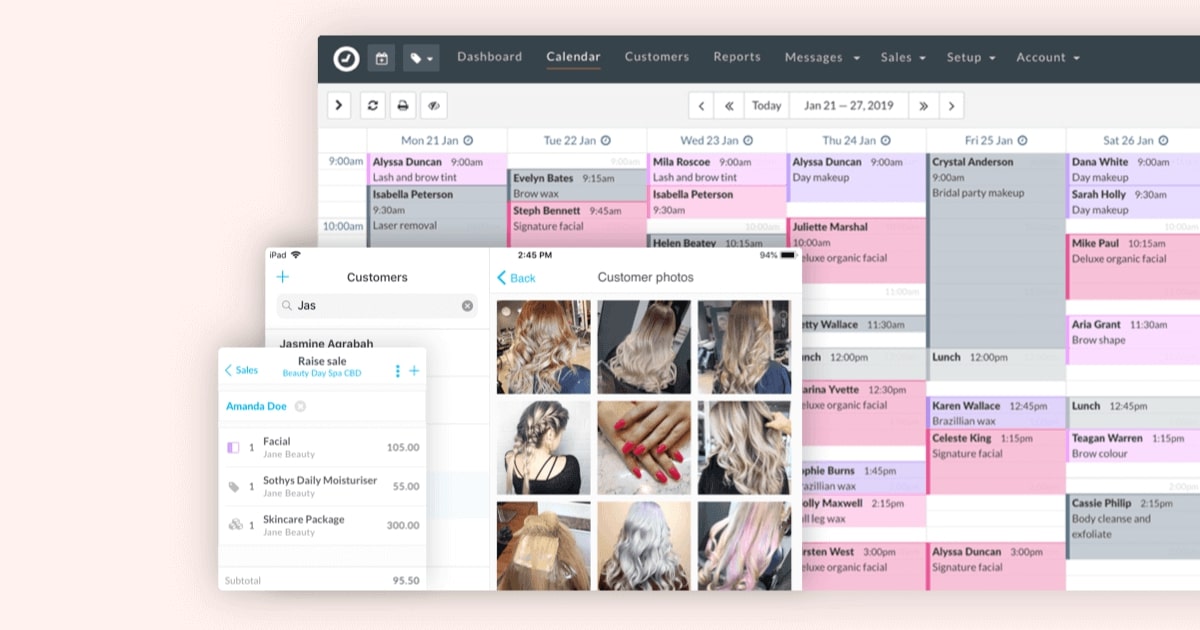
Gettimely (Best balance)
- Class scheduling and one-on-one appointments
- Membership and package management
- Client CRM with engagement tracking
- Integrations: QuickBooks, Xero, Mailchimp
- Multi-location support
- Cost: $11+/month (Starter); $20+/month (Premium)
- Best for: Growing wellness centers wanting strong features at lower cost
FrontDeskChat (Best affordable option)
- One-on-one appointment scheduling
- SMS reminders and online payments
- Basic client CRM
- Workaround: Create recurring “class slots” as appointments
- Cost: Free to $8-18+/month
- Limitation: Not designed for group class management
- Best for: Solo practitioners, small centers, budget-conscious operations
Google Calendar + Zapier + Stripe (Budget DIY)
- Google Calendar for scheduling
- Zapier for automated reminders and CRM updates
- Stripe for payment processing
- Total: Free + $20/month (Zapier) plus transaction fees
- Requires technical skill to set up
- Best for: Tech-savvy operators with minimal budgets
Implementation guide: Wellness center scheduling
Phase 1: Choose platform (2-4 hours)
- If you offer classes: Mindbody or Vagaro (both handle class scheduling well)
- If only one-on-one: FrontDeskChat or Acuity (simpler, lower cost)
- If mixed: Mindbody or Gettimely
- Trial each before committing
Phase 2: Set up instructors and staff (1 hour)
- Add each instructor with name, photo, bio, and certifications
- Set teaching specialties (beginner yoga, advanced pilates, HIIT)
- Set availability by class and day
Phase 3: Create classes (2-3 hours)
- For each class: name, schedule, instructor, capacity, pricing
- Example: “Monday 6 PM Hatha Yoga, Sarah, 20 max, $20”
- Set as recurring for regular weekly classes
Phase 4: Set up memberships and packages (1 hour)
- Unlimited membership: $99/month (with trial offer for new members)
- Class packages: 10 classes for $150 (expire after 90 days)
- Drop-in: $20 per class
- Enable auto-billing for memberships
Phase 5: Set up one-on-one appointments (1 hour)
- Private training, coaching, massage, or specialty sessions
- Different from classes: individual, flexible time
Phase 6: Build client intake form (1 hour)
- Fitness level and injury history
- Goals and service preferences
- Preferred times and instructors
- Contact preference (SMS or email)
- Emergency contact
Phase 7: Configure reminders (30 minutes)
- Class reminders: email day before, SMS 2 hours before
- Appointment reminders: email 24h before, SMS 1h before
- Include instructor name, studio address, and any prep instructions
Phase 8: Add retail inventory (optional, 1 hour)
- List products: mats, oils, supplements
- Set pricing and track stock
- Set reorder alerts
Phase 9: Set up email marketing (1 hour)
- Welcome sequence for new members
- Monthly class schedule email
- Re-engagement automation: “You haven’t visited in 30 days”
- Birthday discount: automated on birthday
Phase 10: Train staff (2 hours)
- How to check class rosters and manage no-shows
- How to refund a class or membership
- How to process retail sales
- How to communicate with clients via SMS or email
Total setup time: 12-16 hours
Wellness center best practices:
Fight no-shows with multi-channel reminders
- Email 24h before: “Yoga class tomorrow 6 PM with Sarah”
- SMS 2h before: “Hatha Yoga with Sarah starts in 2 hours! Text CANCEL to cancel”
- Result: 20-30% no-show drops to 8-10%
Push membership over drop-in
- Drop-in: $20/class
- Membership: $99/month (roughly 5 classes to break even)
- Once a client joins membership, monthly churn drops to under 5%
- Target 70%+ of revenue from memberships
Track client engagement by the numbers
- Frequency: classes per month
- Favorite instructors and class types
- Attendance trends over time
- Use this to send personalized outreach: “You love Vinyasa. New Tuesday advanced class starting next month.”
Re-engage inactive members before they churn
- Day 30: “Miss you! 10% off this week”
- Day 60: “Your last class was 2 months ago. 20% off to come back”
- Day 90: “Special offer inside. Come back and see what’s new”
- Well-designed re-engagement recovers 20-30% of clients who would otherwise leave quietly
Use a trial offer to get new members committed
- “First month $25 (usually $99)”
- Data shows: if a new member attends 4+ classes in the first month, 60%+ stay long-term
- The trial offer removes the financial barrier to that first commitment
Create scarcity in popular classes
- “Only 3 spots left in Tuesday 6 PM Vinyasa”
- Encourages booking in advance
- Makes last-minute planning harder, which reduces no-shows
Cross-sell retail at the right moment
- After class: “Grab a mat or oil before you leave”
- 100 classes per month × $10 average retail add-on = $1,000 in additional monthly revenue
Build community intentionally
- Facebook group for members to share progress and encouragement
- Monthly post-class social (tea, smoothies, or a casual meetup)
- Community creates emotional bonds that retention campaigns can’t replicate
- Members with community connections refer friends
Track revenue by source
- Classes vs. memberships vs. retail vs. private sessions
- Know which is your most profitable service type
- Double down on what works
Real-world example: 10-instructor yoga studio
Studio: 15 classes per week, 500 members plus drop-ins
Setup: Mindbody for all scheduling, memberships, and client CRM. Email and SMS reminders.
Revenue model:
- Unlimited memberships: 300 × $99/month = $29,700
- Class packages: 100 packages × $150 = $15,000
- Drop-in: 200 × $20 = $4,000
- Retail: $1,000
- Total: $49,700/month
Retention focus:
- Day 30 inactive: “Miss you! 10% off”
- Day 60 inactive: “20% off if you book this week”
- Result: 75% annual retention (industry average is 60%)
Client lifecycle:
- New member pays $25 trial (4 weeks)
- Month 2: joins $99 membership
- Months 2-6: attends 3 times per week
- Month 6: attendance drops (life gets busy)
- Day 60 inactive: receives re-engagement email
- Month 7: returns with 10% discount
- Months 8+: back to regular attendance
Class scheduling strategies:
Variety by time of day
- Morning (6-7 AM): professionals before work
- Lunch hour (12 PM): flexible workers and nearby offices
- Evening (6-7 PM): busiest and highest attendance
- Different segments, different needs
Instructor-focused promotion
- “Sarah’s Tuesday Vinyasa” builds a following
- Popular instructors drive bookings
- Premium time slots for popular instructors
Level-based segmentation
- Beginner, intermediate, and advanced classes prevent intimidation
- New students don’t feel overwhelmed in a beginner class
- Market explicitly: “New to yoga? Start with Beginner Hatha”
Specialty classes
- Hot yoga, restorative, HIIT, meditation
- Different classes attract different demographics
- A broader portfolio serves a wider market
Capacity-based pricing
- Intimate class (8-10 people): $25 premium pricing
- Standard class (15-20 people): $20
- Large class (30+ people): $15
- Pricing signals the experience level
Membership types and pricing:
Unlimited: $99/month. Highest commitment, most stable revenue. Best for retention.
Class packages: 4 classes/month ($60), 8 classes/month ($100), unlimited ($120). Clients self-select based on their usage pattern.
Hybrid pricing: $79 for 8 classes, then $15 per extra class. Encourages membership while monetizing heavy users.
Annual discount: Monthly $99, annual $1,000 (saves $188). Upfront payment improves cash flow and signals commitment.
Multi-location management:
Unified class schedule: Clients see all locations’ classes in one view. Book downtown on Monday, uptown on Wednesday. No separate accounts.
Unified membership: Works at all locations without confusion. Clients aren’t locked to one studio.
Client CRM across locations: History, preferences, and notes follow the client regardless of which location they visit.
Staff scheduling: Instructor Sarah teaches at two locations. System prevents double-booking automatically.
Revenue reporting by location: See which location generates the most revenue and which classes perform best where.
Client retention by stage:
Stage 1: Pre-join (days 0-14) Trial offer and expectation setting. Goal: get them to 4+ classes in the first month.
Stage 2: Early member (weeks 2-8) Welcome email, instructor intro, gamification (10 classes earns a free mat). Goal: build the habit.
Stage 3: Established member (months 2-6) Deepen engagement. Personalized class suggestions. Community invitation. Retail recommendation. Goal: make them feel connected, not just subscribed.
Stage 4: At-risk (attendance drops) Re-engagement campaigns at 30 and 60 days. Survey to understand why they’ve been absent. Goal: win them back before they cancel.
Stage 5: Churned (3+ months inactive) Final offer at 30% off. If no response, move to inactive list. Accept the loss, focus retention efforts on current members.
Wellness center metrics:
| Metric | Target |
|---|---|
| Monthly churn rate | Under 5% |
| Attendance per member | 8+ classes/month |
| Membership adoption | 70%+ of all clients |
| Class no-show rate | Under 15% |
| Revenue per member | $120+/month |
| Retail attach rate | 10-15% of attendees |
| New member retention at 3 months | 60%+ |
Common wellness center mistakes:
- No CRM: can’t track which clients are at risk of leaving
- Separate class and appointment systems: confusing for clients
- No reminders: 30% no-show rates become normal
- Only drop-in pricing: revenue is unpredictable, retention is poor
- No differentiation by instructor or class intensity
- Ignoring inactive members: 20-30% could be re-engaged with a simple email
- Not tracking metrics: impossible to optimize what you don’t measure
- Weak community: clients attend classes but feel no connection, making it easy to switch studios
- Complicated booking: any friction sends clients to a competitor
- No trial offer: new members don’t commit, conversion stays low
Wellness center technology stack:
| Tool | Purpose | Cost |
|---|---|---|
| Mindbody | Scheduling, CRM, billing, classes, inventory | $99+/month |
| Vagaro | Scheduling, classes, CRM, payments | $40+/month |
| Gettimely | Scheduling, classes, CRM, integrations | $11-28+/month |
| FrontDeskChat | Appointment scheduling, SMS, payments | $8+/month |
| Mailchimp | Email marketing | Free/$20+/month |
| Zapier | Automation (email on booking, CRM updates) | $20+/month |
| Stripe | Payment processing | 2.9% + $0.30/transaction |
| Google Analytics | Website traffic and conversion tracking | Free |
| Total | $100-200+/month |